Camping Guides
How Many Solar Panels Does Your RV Need?
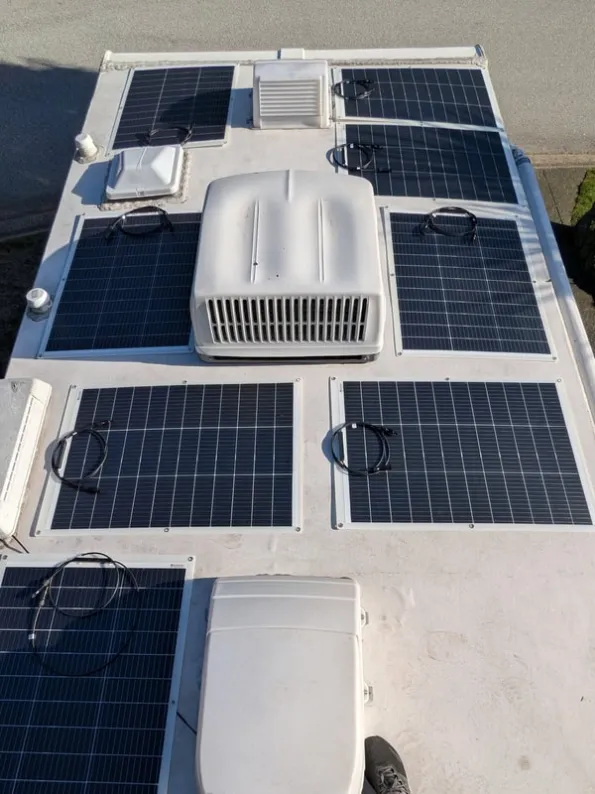
How many solar panels does your RV need? The short answer is 2 to 6 panels, or roughly 400W to 1,200W of solar power, for most RVs. But the honest answer is that the number depends on how much electricity you use each day, how much sun you get, and how long you stay off grid. A panel count alone means little. Two 200W panels and four 100W panels both make a 400W array. What matters is total watts, battery storage, and your daily habits.
Start with your daily power use. Make a simple list. Lights, a water pump, phone chargers, and a fan are light users. A 12V fridge, a laptop, a Starlink dish, or a CPAP machine changes the picture fast. As a rough guide from current RV solar guides, weekend campers running just lights and a phone charger often get by with 200W to 400W. A family running a fridge, lights, fans, and laptops usually needs 400W to 600W. Boondockers who stay off grid for days often need 600W to 1,000W. Full-time off-grid RVers commonly need 800W to 1,200W or more, especially with Starlink, a microwave, or a home office. These are market reference ranges, not a quote for any specific kit.
Then do the simple math. Add up what you use in a day in watt-hours. A device that uses 100 watts for 3 hours uses 300 watt-hours. Add everything together for a daily total. Then divide that total by the peak sun hours where you camp. Most of the continental United States gets about 4 to 6 peak sun hours a day, but the desert Southwest gets more and the cloudy Pacific Northwest gets less. Finally, add a buffer of 20 to 35 percent for dust, shade, imperfect angles, and cloudy days. For example, 1,500 watt-hours a day divided by 5 sun hours is 300 watts of panels in perfect conditions. With a buffer, that becomes about 400 watts in the real world. That is why a 400W kit is the most common starting point.
Panels are only half the system. Solar panels charge your batteries during the day. Your batteries power your RV at night and on cloudy days. If your battery bank is too small, extra panels will not help, because there is nowhere to store the power. Size the battery bank for one to two days without sun. For about 1,000 watt-hours of daily use, two days means about 2,000 watt-hours of storage, or roughly 166 amp-hours of usable lithium capacity at 12 volts. Lithium batteries are the usual choice now because they charge faster and you can use more of their capacity than older lead-acid batteries. You also need a charge controller, and a pure sine wave inverter if you run household appliances. A 2,000-watt inverter covers most RV loads. Air conditioning or an induction cooktop calls for 3,000 watts or more, plus a soft-start device, and frankly, running air conditioning on solar alone is a big and expensive system.
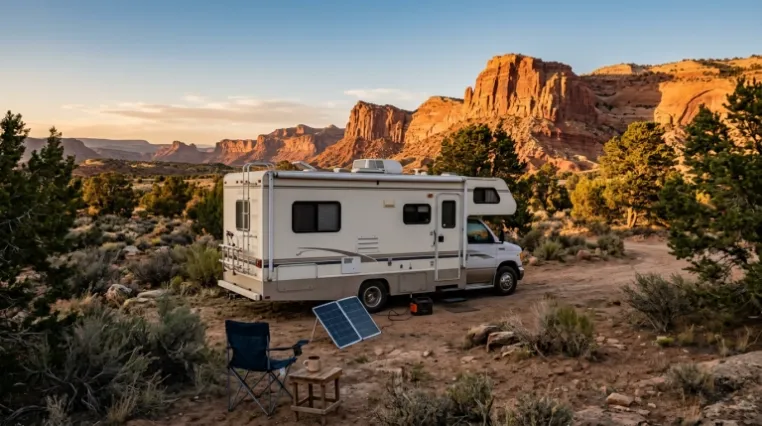
Roof space is the practical limit many people forget. Count your usable roof area before you buy panels. Air conditioners, vents, skylights, and antennas all take space. Portable panels are a good answer if your roof is full or you park in shade. You can place a portable panel in the sun while the RV sits under trees, and fold it away when you drive. Many weekend campers start with one portable panel and a small power station, then add roof panels later.
Roof panels and portable panels solve different problems, and many experienced RVers end up with both. Roof panels work while you drive, charge whenever the sun is out, and never need setting up. Their weakness is shade. If you park under trees to stay cool, your roof panels sit in shade too, and output drops sharply. Portable panels fix that. You can park in the shade and place the panel in the sun, move it through the day, and fold it away when you leave. Their weakness is that you have to set them up, watch them, and store them, and they are easier to steal. A good middle path is roof panels for everyday charging plus one portable panel for shady sites and cloudy weeks. That combination covers more situations than either one alone.
Battery choice matters as much as panel count. Older lead-acid batteries are cheaper, but you can only use about half their capacity without damaging them, and they charge slowly. Lithium batteries cost more up front, but you can use nearly all their capacity, they charge faster, and they last far longer. For most people building a new system, lithium is the better buy over the life of the RV. Whatever battery you choose, add a battery monitor that shows real amp-hours in and out. Guessing from voltage alone is how people run out of power at midnight. A simple shunt-based monitor pays for itself the first time it saves a dead battery.
Start small, measure, then grow. Install a 400W starter setup, camp off grid for two or three nights close to home, and watch your battery meter. If you run out of power by the second morning, add panels or batteries, not both at once. And remember that water usually runs out before power does, so plan for water and waste at the same time as power. If you want help sizing a kit for your RV, contact DAN at Touring Car Supplier — 1367852516@qq.com or 008613860654699 — and tell us how you camp. We will help you size it from your real daily use, not from a marketing number.