Camping Guides
RV Boondocking Gear: 7 Essentials for Off-Grid Camping
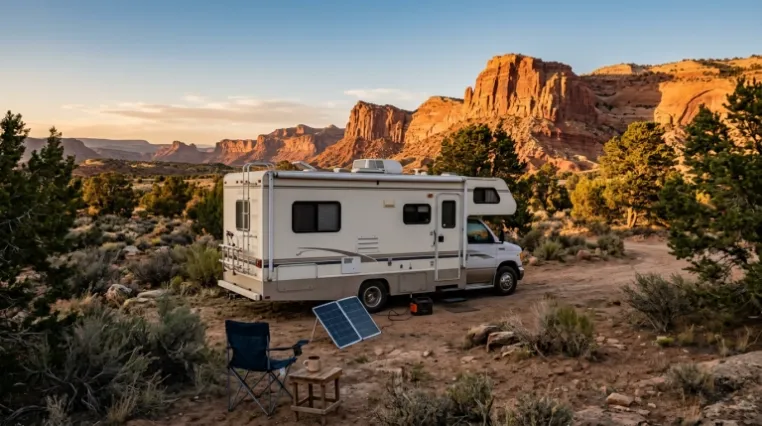
Boondocking is camping with no hookups: no power post, no water tap, no sewer connection. Just your RV, a piece of open land, and whatever you brought with you. Done right, it is the cheapest and quietest way to travel. Done wrong, it is a dead battery at midnight and an empty water tank on day two.
The gear below is what experienced boondockers actually carry, in the order that matters. It is not a shopping list for a store — it is the system that keeps you out there.
- Solar panels and a battery bank
Power is the first limit, so it comes first. Solar panels charge your batteries during the day; your batteries run the RV at night. As a rough guide from current RV solar guides, most RVs need 2 to 6 panels, or roughly 400W to 1,200W of solar power. Weekend campers running just lights and a phone charger often get by with 200W to 400W. Full-time off-grid RVers commonly need 800W to 1,200W or more, especially with a Starlink dish, a laptop, or a home office. These are market reference ranges, not a quote for any specific kit.
Size the battery bank for one to two days without sun. Lithium batteries are the usual choice now because they charge faster and you can use nearly all their capacity, unlike older lead-acid batteries. Add a battery monitor that shows real amp-hours in and out. Guessing from voltage alone is how people run out of power at midnight.
- A portable power station
Roof panels work while you drive, but they sit in shade when you park under trees to stay cool. A portable power station with a folding panel fixes that: park in the shade, place the panel in the sun, and charge where the light is. It also powers phones, laptops and a fan outside the RV, and it is the backup when the main battery bank runs low. Keep it charged before you leave the last town — an empty backup is no backup.
- Water — more than you think
Water runs out before power does, almost every time. A boondocker uses water for drinking, cooking, washing and the toilet, and most RV fresh-water tanks last two to four days for two people. Bring extra drinking water in separate containers, even if the tank is full. A simple water filter lets you refill from more sources, and a collapsible water jug is worth its weight on a long stay. Before you park, know where the next water fill is — do not discover the answer when the tank is empty.
- Waste handling
Off-grid camping has no dump station at the site. Know your grey and black tank capacity before you go, and use water sparingly: navy showers, paper plates on the last day, and a dish basin instead of running the tap. A portable waste tote lets you empty tanks without moving the whole RV, which matters when you finally found the perfect spot. Never dump grey or black water on open land. It is illegal in most places, and it is what gets good boondocking spots closed for everyone.
- Levelling and stabilising
Boondocking sites are not paved pads. They slope, they are soft after rain, and they are rarely level. Levelling blocks or ramps keep the RV flat, which matters for sleeping, for the fridge, and for water draining the right way. Wheel chocks stop the RV rolling on a slope. This is cheap gear that prevents expensive problems, and it is the item first-timers forget most often.
- Connectivity and navigation
There is usually no signal where the camping is best, so plan for it. Download offline maps of the whole area before you leave coverage, including the roads in and out — a dirt track that looks fine on a small map can be impassable after rain. A satellite internet dish is the usual answer for people who work from the road, but it needs power, so count it in your daily power budget. Tell someone where you are going and when you expect to be back in coverage. Off-grid should mean self-reliant, not unreachable.
- Safety and comfort basics
The last essentials are the least exciting and the most used: a first-aid kit, a fire extinguisher, a headlamp, and a way to make shade. Awnings and outdoor chairs turn the side of the RV into a living room, which is where you will spend most of the day. A simple tool kit — fuses, a tyre pressure gauge, duct tape, cable ties — fixes most small problems before they become big ones. And a paper map, in case the phone dies. The desert does not care that your battery is at 2 percent.
Start close to home. Camp off grid for two nights within an hour of a town, watch your battery meter and your water gauge, and write down what ran out first. That list is your real shopping list for the next trip — not a catalogue, but your own experience.
If you want help sizing a solar kit or picking gear for your RV, contact DAN at Touring Car Supplier — 1367852516@qq.com or 008613860654699 — and tell us how you camp. We will help you size it from your real daily use, not from a marketing number.